
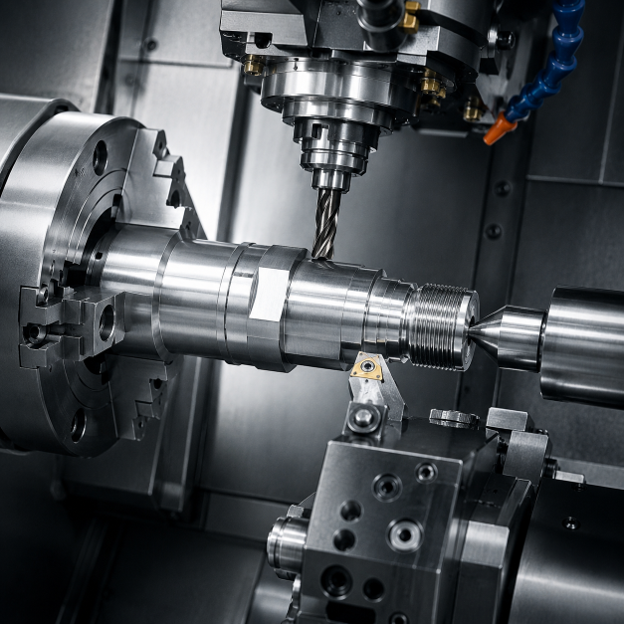
There is a moment in traditional machining when a part comes off the lathe, gets cleaned up, and then sits in a queue waiting for the milling machine to become free. That wait costs money. It introduces handling errors. It adds setups, and every additional setup is another opportunity for tolerance to drift. CNC turn-mill machining was developed to eliminate that moment entirely.
The technology combines turning and milling into a single machine, a single setup, and a single continuous process. The part does not move between operations. The tolerances stack in your favour rather than against you.
What Is CNC Turn-Mill Machining?
A conventional CNC lathe rotates the workpiece while a fixed cutting tool removes material. A conventional machining centre holds the workpiece still while a rotating tool cuts across it. Turn-mill combines both capabilities in one platform.
The workpiece can rotate as in turning. The spindle can also hold driven tools that rotate independently, allowing milling, drilling, tapping, and contouring operations to happen on the same machine without rechucking the part. Many turn-mill centres add a Y-axis to the traditional X and Z, enabling off-centre features, cross-holes, flats, and complex profiles that a standard lathe cannot produce.
High-end machines add a sub-spindle, which accepts the part from the main spindle and allows the reverse face to be machined without manual intervention. The part enters as raw material and exits completely finished.
Key Benefits Of CNC Turn-Mill Machining
CNC turn-mill machining is chosen when a component needs accuracy across several features, not just fast metal removal. Its main advantages include:
- Fewer setups between turning and milling operations
- Better positional accuracy because the part stays in one clamping
- Shorter lead times for complex components
- Lower handling risk between machines
- Reduced work-in-progress inventory
- Better consistency across repeat batches
- Ability to machine both front and back faces with a sub-spindle
- Stronger economics for complex parts made in small to medium volumes
The biggest gain is not always cycle time alone. In many shops, the real value comes from removing setup variation, queue time and manual handling.
Turn-Mill Centre vs Lathe With Live Tooling: Why the Difference Matters
This distinction is frequently misunderstood and worth clarifying before specifying equipment.
A lathe with live tooling has driven tool capability but typically operates in two axes. It can drill a cross-hole or mill a flat, but its Y-axis movement is limited or absent, and its structural rigidity under heavy milling loads is often compromised.
A true turn-mill centre is built from the ground up as a multi-tasking platform. The machine structure, spindle design, and control architecture are engineered for sustained milling alongside turning. The Y-axis is fully supported and properly aligned. The control handles simultaneous multi-axis interpolation. The tooling capacity is significantly larger.
The practical difference shows up in part complexity, surface finish, and cycle time. A lathe with live tooling is adequate for simple secondary features. A turn-mill centre is the correct choice when the part genuinely demands it.
Which Components Benefit Most From Turn-Mill Machining?
Not every part justifies a turn-mill centre. The technology delivers its greatest advantage on components that would otherwise require multiple setups across different machines.
Components that typically benefit include:
- Shaft components with milled flats, keyways, cross-holes, or eccentric features
- Hydraulic valve bodies and manifolds requiring precise intersecting bores
- Medical implants and surgical instruments where dimensional accuracy is non-negotiable
- Aerospace structural components with complex external profiles and internal features
- Automotive transmission shafts with splines, grooves, and gear features
- Fluid system connectors and fittings in stainless steel or titanium
- Oil and gas downhole tools where material is expensive, and tolerances are tight
The common thread is geometric complexity combined with a requirement for positional accuracy between features. When those two conditions are met, consolidating operations into a single setup improves both quality and economics.
How Multi-Axis Control Expands What Is Geometrically Possible
The capability of a turn-mill centre is closely tied to its axis configuration. Entry-level machines operate in three or four axes. Advanced machines work in five or more, with simultaneous interpolation allowing the cutting tool to maintain optimal engagement with complex
Five-axis turn-mill machining enables undercuts, compound angles, and sculptured surfaces that would be impossible or prohibitively expensive to produce through sequential conventional operations. Impeller blades, medical bone screws with helical features, and turbine components with freeform external geometry are all produced more efficiently on five-axis turn-mill platforms than through any alternative route.
The control system carries much of the burden here. Modern turn-mill controls handle tool centre point management, collision avoidance, synchronised spindle coordination, and thermal compensation automatically. The programmer defines what the part should look like. The control manages the physics of getting there.
Material Behaviour and How It Affects the Turn-Mill Process
Turn-mill machining handles a wide range of materials, but process parameters differ considerably between them.
Mid-hardness steel alloys are the most forgiving. Stainless steels, particularly austenitic grades, require careful chip control and consistent coolant delivery to prevent work hardening during turning operations. Titanium demands lower cutting speeds, high-pressure coolant, and sharp tooling throughout to manage heat and prevent built-up edges. Aluminium runs at much higher speeds and benefits from the cycle-time advantages of turn-mill more than almost any other material, because the raw removal rates are so high.
Difficult materials such as Inconel, Hastelloy, and cobalt-chrome alloys are where the rigidity of a proper turn-mill centre matters most. These materials punish any vibration or instability in the cutting system. A machine built for sustained multi-tasking handles them more reliably than a lathe pressed into service for milling.
Programming a Turn-Mill Centre: What Makes It More Demanding
Turn-mill programming is more demanding than programming either a lathe or a machining centre in isolation. The programmer must coordinate turning and milling operations, manage tool changes across a larger magazine, synchronise dual spindles where fitted, and sequence operations to avoid collision while minimising non-cutting time.
CAM software has matured considerably to support this. Systems such as Mastercam, HyperMill, and Siemens NX generate turn-mill toolpaths with built-in collision checking, machine simulation, and cycle-time optimisation. Post-processors must be matched carefully to the specific machine and control combination, as generic posts produce inefficient or unsafe code on complex multi-tasking platforms.
Simulation before cutting is not optional. A collision on a turn-mill centre involves significantly more tooling, fixturing, and machine structure than a collision on a simpler machine. The cost of a crash is proportionally higher.
Conclusion
Turn-mill centres carry a higher capital cost than conventional lathes or machining centres. The investment is justified when the work demands it, and not before.
The strongest savings usually come from fewer setups, lower work-in-progress inventory, shorter lead times, improved part consistency, and less manual handling between machines. Turn-mill machining makes the most sense for complex parts produced in small to medium batches, especially when positional accuracy between features is critical.
Before you invest, ask a simple question: how many times does this part move between machines before it’s done? Three or four setups isn’t just extra machine time. You’re also paying for queue time, inspection time, handling risk, and tolerance drift between operations. This is exactly where turn-mill machining pays for itself.
For enquiries, reach us as follows:
Email: sales@offshoresynergy.ae
Phone: +971 7 208 1300
Website: www.offshoresynergy.ae
