
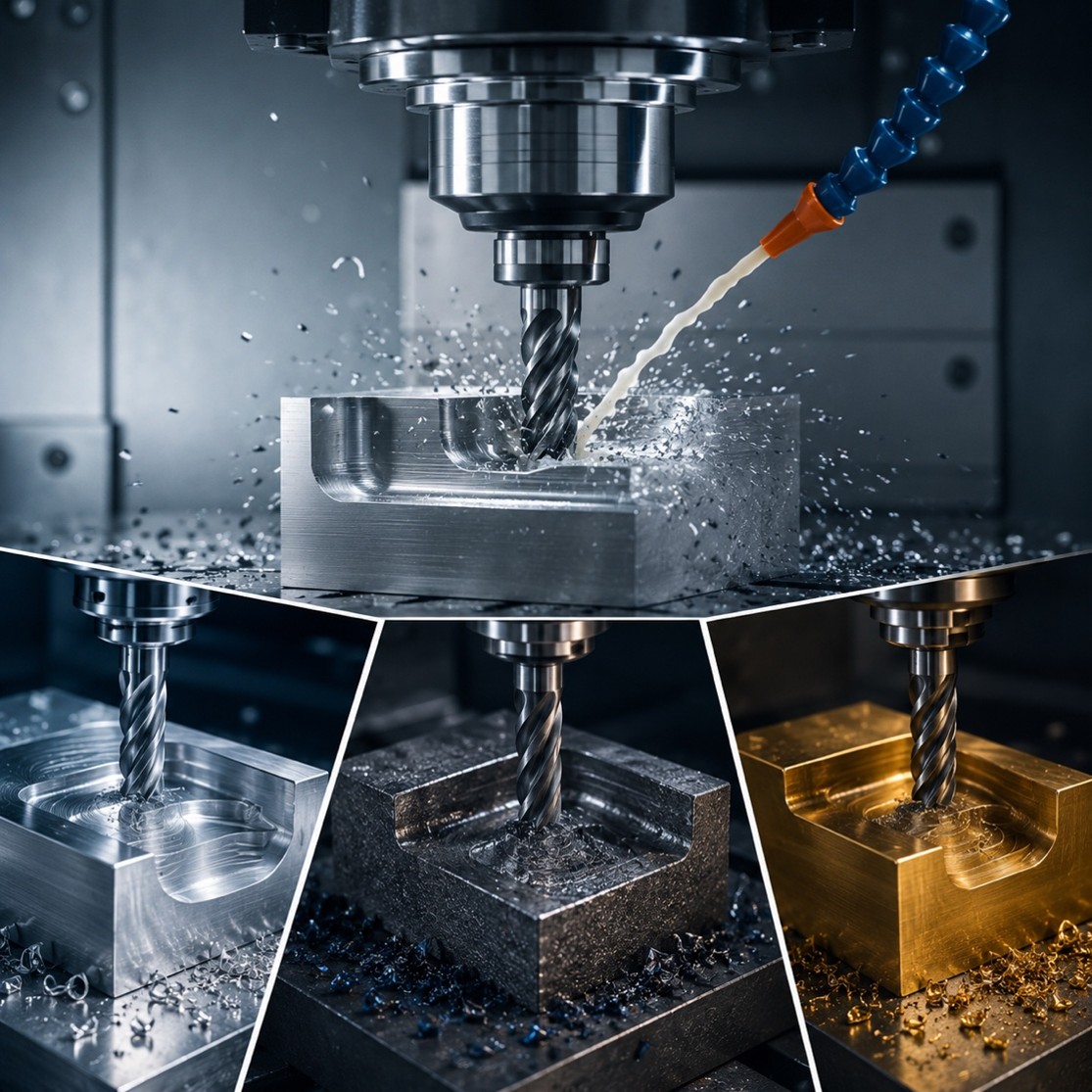
A machining strategy built for aluminium will damage a titanium tool budget within a single production run, and a program tuned for stainless steel will burn through cycle time on a soft alloy that never needed that level of caution. Material behaviour dictates cutting speed, tool geometry, coolant strategy and tolerance achievability long before part geometry enters the conversation. Shops that treat material selection as a specification note rather than a machining variable end up paying for it in tool wear, scrap rate and missed delivery dates.
Most quoting mistakes in CNC manufacturing do not come from bad geometry reads. They come from applying a generic feed and speed table to a material that behaves nothing like the one that table was built around. A shop that runs aluminium profitably all week can still lose money on a titanium job priced the same way, because the two materials fail differently under a cutting edge, and that difference changes almost every decision downstream.
Material Behaviour Sets the Ceiling Before the Program Is Written
Every material has a thermal conductivity, work hardening tendency and chip formation pattern that determines how fast material can safely be removed. Aluminium conducts heat away from the cutting zone quickly, which lets shops run high spindle speeds without cooking the tool edge. Titanium behaves very differently. Its low thermal conductivity leaves more heat concentrated around the cutting edge, so tool life can fall quickly if cutting speed and coolant delivery are not controlled.
The consequence shows up in the tool crib, not the part. A shop pricing a titanium bracket using aluminium era tool life assumptions finds inserts failing at a third of the expected volume, and by the time that gets flagged, the job has already gone out under margin.
What Is Wearing the Tool?
Abrasion and adhesion are two common causes of tool wear, but they rarely act in complete isolation. Identifying which mechanism is doing most of the damage helps a shop change the right part of the process.
Abrasive wear: Hard, gritty microstructures, cast iron and certain hardened steels being the clearest examples, physically grind away the cutting edge through mechanical contact. The fix here is tool material hardness and coating, since a harder carbide grade or a ceramic insert resists the abrasion directly. Slowing the feed rate barely helps, because the wear mechanism is contact based, not heat based.
Adhesive and thermal wear: Titanium, stainless steel and other gummy, heat retentive alloys cause material to weld onto the cutting edge under high localised temperature, then tear away and take tool material with it. The fix here is almost the opposite of pathway one. Lower cutting speeds, sharper edge geometry and aggressive coolant delivery reduce the heat buildup that drives the welding action in the first place. Throwing a harder insert at this problem without addressing heat does very little, since the failure was never about mechanical grinding.
Confusing these two pathways is the single most common reason a shop’s standard tooling library underperforms the moment a new material lands on the shop floor.
Material-Specific Parameters That Actually Move the Needle
| Material | Dominant wear pathway | Relative cutting speed | Coolant strategy | Common failure if mismatched |
| Aluminium alloys | Minimal, built-up edge risk | High | Flood or mist, mainly for chip clearance | Poor surface finish from BUE, not tool failure |
| Titanium alloys | Adhesive and thermal | Low | High-pressure coolant often beneficial; through-tool | Rapid edge chipping, work hardening of surface |
| Stainless steel (300 series) | Adhesive with work hardening | Moderate, consistent | Flood coolant, avoid dwell | Work hardened skin causing tool bounce on next pass |
| Tool and hardened steels | Abrasive | Low to moderate | Minimal, coating dependent | Flank wear, edge rounding |
| Cast iron | Abrasive | Moderate | Often dry machined | Excessive dust and rapid flank wear if wet coolant used incorrectly |
This table is a starting reference, not a substitute for trial cuts on a new alloy batch. Material certification sheets vary between suppliers, and even a small shift in hardness or alloy composition within spec can move a job from comfortable to marginal on tool life.
Where Fixtures and Chip Control Change by Material
Material choice does not stop at the cutting edge. It reaches into fixturing and chip evacuation decisions that get overlooked until a job is already running.
- Aluminium: produces long, stringy chips at high speed that wrap around tooling and fixtures if chip breaker geometry is not matched to the feed rate, creating a genuine safety and surface finish risk during unattended cycles.
- Titanium: generates short, hot chips that carry significant thermal energy directly into the fixture if evacuation is poor, which can distort thin walled parts held in standard vice setups.
- Stainless steel: work hardens rapidly if the tool dwells or rubs rather than cuts cleanly, so fixture rigidity matters more here than on softer materials, since any vibration invites a hardened skin that the next pass then has to fight through.
- Grey cast iron: often produces short, brittle chips and abrasive dust, so enclosure, filtration and extraction need more attention than they would on many aluminium or steel jobs.
Tolerance Achievability Is a Material Question, Not Just a Machine Question
A CNC platform capable of holding five microns on aluminium will not automatically hold the same tolerance on Inconel run on the same spindle. Thermal expansion during the cut, tool deflection under higher cutting forces and part cooling after machining all vary by material, and a tolerance stack that ignores this shows up as parts drifting out of spec between the first piece off the machine and the fiftieth in the batch. Shops quoting tight tolerances on difficult alloys without building in measurement checkpoints partway through a run are pricing a risk they have not accounted for.
Building a Material-Specific Process Instead of a Universal One
Treating material as a variable that changes tooling, speeds, coolant and fixturing, rather than a line item on a drawing, is what separates shops that hold margin on difficult alloys from those that quietly lose it. The right approach is not a single master program adapted slightly for each job. It is a library of material specific baselines, tested and refined on real production runs, that a programmer pulls from before a single line of G-code is written.
FAQs
Does material specific machining actually change quoted lead times?
Yes, often significantly. Materials in the adhesive wear pathway, such as titanium, typically need lower cutting speeds and more frequent tool changes, which extends cycle time well beyond what a generic estimate based on aluminium jobs would suggest.
Can the same tool geometry work across different material families?
Rarely without compromise. A geometry optimised for abrasive wear resistance on hardened steel is not the ideal choice for adhesive wear materials like stainless steel, since the two failure mechanisms call for different edge preparation and rake angles.
Is it worth running trial cuts on a new material batch even with certified spec sheets?
Yes. Certification sheets confirm compliance and may include actual test results for the batch, but they do not fully predict how the material will machine. Differences in microstructure, hardness and chip behaviour can still affect tool life and surface finish.
For enquiries, reach us as follows:
Email: sales@offshoresynergy.ae
Phone: +971 7 208 1300
Website: www.offshoresynergy.ae
