
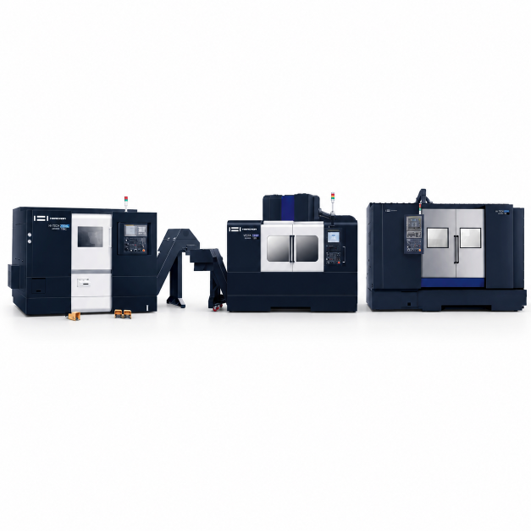
TL;DR: Three Hwacheon machines cover three distinct manufacturing jobs rather than three price points on the same job. The Hi-TECH 230 handles medium-diameter precision turning where repeatability matters more than raw size. The Hi-TECH 550BXL exists for long, heavy shafts and large-diameter components that would overwhelm a smaller lathe’s rigidity. The VESTA-1300+ becomes the better fit when milling is the main operation or the part needs pockets, multiple faces or a larger prismatic work envelope. Choosing between them by part drawing rather than by machine list price is what actually protects tolerance and cycle time.
Even a well-equipped shop can lose time and material when a part is routed to the wrong machine. Equipment lists rarely fail because a machine lacks capability. They fail because a part gets routed to a lathe built for compact precision when it needed the rigidity of a long-bed heavy turning centre instead, or because a milling job gets crammed onto a lathe with live tooling rather than moved to a dedicated machining centre. Matching part geometry to the right platform, before the program is written, is where the real capability of these three machines shows up.
The Hi-TECH 230 Holds Its Ground on Medium-Diameter Work
Depending on the configuration, the Hi-TECH 230 is offered with 8- to 10-inch chuck options and uses box-way construction to support rigidity under cutting load. The larger contact area helps damp vibration during heavier cuts, which can support more consistent machining across repeated cycles.
Spindle power sits at 22 kW with speeds up to 3,500 rpm, while the turn-mill motor delivers 5.5 kW. That combination matters for shops running mixed batches of turned and turn-milled components on the same setup, since switching between straightforward OD turning and live-tool milling operations without a machine change removes a handling step that otherwise introduces its own tolerance risk.
Where this machine earns its place is medium-volume, medium-diameter component work, automotive shafts, hydraulic fittings, pump housings, where the part count is high enough that repeatability across hundreds of cycles matters more than sheer part size.
Long Shafts Need the Extra Bed Length and Torque of the 550BXL
Long, heavy or large-diameter components create a different mechanical problem entirely. As workpiece length increases, deflection under cutting load increases with it, and a lathe without the bed length and box-way rigidity to match starts producing tapered or out-of-round parts well before the operator notices anything wrong on the control screen.
Depending on the configuration, the Hi-TECH 550BXL offers extended turning lengths of up to around 3.2 metres, a spindle motor rated at 30 kW and a maximum cutting diameter of around 590 mm. The extended-length BXL configuration exists specifically for shafts, long tubular components and oversized fittings that need support across their full length rather than just at the chuck end.
High torque at low RPM, delivered through the gear-driven transmission, is the other piece that matters here. Large-diameter turning does not run at high spindle speeds. It runs at low speeds with high torque demand, since surface speed targets on a wide-diameter part are reached at far fewer revolutions per minute than on a small part. A smaller lathe may not provide the same combination of low-speed torque, workholding capacity and rigidity. Routing a large shaft to an undersized machine produces chatter, poor surface finish and shortened tool life, no matter how carefully the program is written.
Once Milling Enters the Picture, the VESTA-1300+ Takes Over
Live-tool turning centres can handle some off-axis holes and milled features, but they stop being the natural choice once milling becomes the main operation or the part needs a larger prismatic work envelope. That is where the VESTA-1300+ becomes the more suitable platform.
With a 1,300 mm X-axis travel, 670 mm Y-axis travel and 650 mm Z-axis travel, a 1,300 kg table load capacity, and spindle speeds reaching 12,000 rpm, this machine handles component families ranging from compact brackets to larger structural parts within a single work envelope. The 30-position tool magazine supports genuinely mixed operations, drilling, tapping, roughing and finishing, without a manual tool change interrupting an otherwise automated cycle.
The structural detail that matters most here is thermal management. Both the spindle and frame incorporate cooling designed to minimise thermal displacement, and this is not a cosmetic spec. During long unattended cycles, unmanaged heat can shift the relationship between the tool and the part, increasing the risk of dimensional drift. Cooling and thermal compensation help control that movement, although regular measurement remains important for tight-tolerance work.
Matching the Machine to the Part, Not the Part to the Machine
| Machine | Core strength | Best suited to | Weak fit for |
| Hi-TECH 230 | Repeatable precision turning at moderate diameter | Medium-volume shafts, fittings, turn-mill components | Parts over 400 mm diameter or requiring extensive milled geometry |
| Hi-TECH 550BXL | High torque, long-bed rigidity | Long shafts, large-diameter components, hard turning | Small, high-volume precision parts where cycle time efficiency matters more than size capacity |
| VESTA-1300+ | Milling accuracy with thermal stability | Multi-face components, pockets, brackets, complex 3D geometry | Purely rotational parts better suited to a lathe from the start |
Routing decisions built around this table, rather than around whichever machine happens to be free, are what keep tolerance consistent and tool budgets under control across a mixed production schedule.
The Real Advantage Is in the Fit, Not the Spec Sheet
None of these three machines is the better machine in isolation. The Hi-TECH 230 is better suited to a small precision shaft, while the 550BXL becomes the stronger fit as the part grows longer, heavier or larger in diameter. The genuine capability advantage in a shop running all three comes from routing discipline, sending each part to the platform actually built for its geometry, rather than defaulting to whichever machine has the shortest queue that day.
FAQs
Can the Hi-TECH 230 handle the same diameter range as the Hi-TECH 550BXL?
No. The 230 is built around 8- to 10-inch chuck capacity for medium-diameter work, while the 550BXL is designed for large-diameter, long-bed turning up to around 590 mm cutting diameter and turning lengths of up to around 3.2 metres, a genuinely different job.
Does the VESTA-1300+ replace turning operations entirely for a shop that has one?
No. Turning centres and machining centres solve different geometric problems. The VESTA-1300+ handles milled features, pockets and multi-face work, but rotationally symmetric parts still turn faster and more economically on a lathe like the Hi-TECH 230 or 550BXL.
Is high spindle speed always the priority when comparing these machines?
Not necessarily. The 550BXL’s strength is high torque at lower RPM for large-diameter cutting, while the VESTA-1300+’s 12,000 rpm ceiling suits fine milling and finishing work. Matching speed and torque characteristics to the actual operation matters more than chasing the highest number on a spec sheet.
For enquiries, reach us as follows:
Email: sales@offshoresynergy.ae
Phone: +971 7 208 1300
Website: www.offshoresynergy.ae
