
Manufacturing has always involved removing material, shaping metal, and holding dimensions. What changed is how unforgiving the tolerance window has become. Pressure systems that once accepted a few hundredths of a millimetre of variation now demand tighter control.
Rotating assemblies that ran acceptably with minor concentricity error now transfer that error into bearing fatigue within months. The components have not become more fragile. The systems they operate inside have become more integrated, more compact, and less forgiving of dimensional drift.
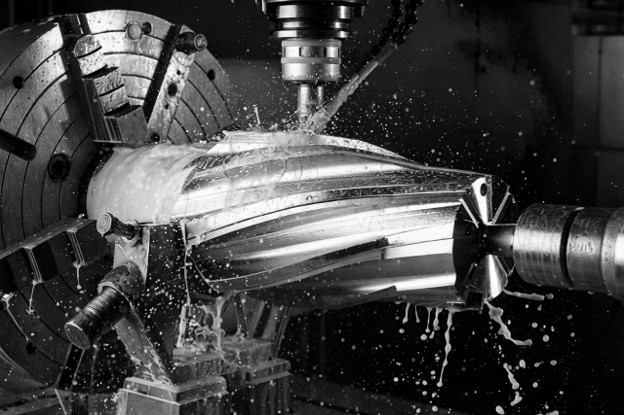
CNC machining is central to how modern industry responds to that pressure. It converts digital engineering data into physical components with measurable, repeatable accuracy across materials, geometries, and production volumes that no manual process could sustain consistently.
What Manual Machining Could Not Reliably Deliver
Experienced machinists have produced high-quality parts for generations. The limitation was never skill. It was scalability. Every manual setup introduced small human variables: feed pressure variation, tool positioning differences, fatigue across long production runs, and inconsistent coolant application. A single skilled machinist might hold tight tolerances across ten parts. Holding those same tolerances across five hundred parts, across multiple shifts, with interchangeable dimensional accuracy between every unit, required something fundamentally different.
CNC machining addressed that by moving control from the operator’s hands to the programme. CAD and CAM software translate engineering drawings into machine-readable toolpaths that govern spindle movement, cutting depth, feed rate, and machining sequence with consistency that does not degrade across a production run. The hundredth part machines the same as the first because the programme executes identically, not approximately.
This also changed how engineers approached component design. Rather than constraining geometry to what a machinist could reliably produce by hand, designs could be built around functional performance requirements first, with CNC systems programmed to execute whatever geometry those requirements demanded.
Dimensional Accuracy as a Functional Requirement
A pump housing with bore misalignment does not fail at installation. It runs, loads its bearings unevenly, generates heat at the contact surface, and accelerates wear over months of operation. A turbine component with slight dimensional inconsistency changes airflow behaviour across the blade profile in ways that pressure measurements may not immediately identify. A valve seat with poor concentricity seals acceptably under low pressure and leaks under the load conditions it was actually specified for.
Dimensional deviation changes how forces distribute across connected systems. Misalignment increases friction. Friction generates heat. Heat alters material behaviour and clearances. Equipment degrades faster than its design life predicted, and the root cause is a dimension that was never correct to begin with.
CNC machining addresses this by maintaining controlled tolerances across complex geometries and across production batches, so the deviation that triggers this chain never enters the system in the first place.
How CNC Machining Serves Different Industries
The underlying precision capability of CNC machining adapts across industries with very different engineering demands, without requiring a different production philosophy for each one.
In aerospace manufacturing, the challenge is structural integrity at minimum weight. Lightweight alloys such as titanium and aluminium require precise machining to maintain strength without introducing stress concentration at machined edges or interfaces. Turbine components, landing gear assemblies, and structural brackets rely on tight tolerances because assembly clearances in aerospace systems leave almost no room for dimensional variation to accumulate.
In oil and gas manufacturing, the challenge is pressure containment under corrosive conditions. Valve bodies, flanges, sealing surfaces, and couplings must hold their geometry under thermal cycling, mechanical load, and chemical exposure. Minor irregularities at sealing faces change how pressure distributes across the joint, and offshore environments offer no straightforward path to intervention when that joint fails.
In automotive and electric vehicle manufacturing, weight reduction competes directly with structural integrity. Battery housings, gearbox components, and suspension parts are machined to optimise geometry whilst preserving load-bearing capacity. Tighter emissions targets and efficiency demands have pushed tolerances in automotive machining closer to what aerospace required a decade ago.
In medical device manufacturing, the constraint is both dimensional and biological. Implants and surgical instruments that contact biological systems cannot tolerate surface irregularities or dimensional failures that would be acceptable in structural engineering applications. CNC machining enables the controlled, repeatable production those components require.
Material Behaviour and Why It Cannot Be Ignored
No single material serves every industrial environment, and the practical value of CNC machining depends partly on how well it handles that variation. Offshore systems need corrosion resistance. Aerospace structures need high strength-to-weight ratios. Industrial automation components may need thermal stability or controlled friction behaviour over millions of operating cycles.
Stainless steel, carbon steel, aluminium alloys, titanium, Inconel, brass, copper, engineering plastics, and composite materials all behave differently under cutting load. Titanium generates concentrated heat at the tool interface that accelerates wear without careful speed and coolant management. Inconel work-hardens during cutting, which changes how subsequent passes behave if parameters are not adjusted between them. Engineering plastics require clamping strategies that avoid introducing dimensional distortion before the tool makes contact.
Machinists adjust tooling geometry, spindle speed, coolant delivery, and cutting depth based on what the specific material will do under load. That process knowledge is what separates machined components that hold their geometry in service from components that measured correctly at ambient temperature and drifted under operating conditions.
Multi-Axis Machining and Reduced Setup Error
Older machining setups required repositioning parts between operations to access different surfaces. Each repositioning introduced alignment variation. Complex geometries required multiple fixtures, extended setup time, and careful attention to how cumulative error built across operations.
Multi-axis CNC systems improved this process by allowing cutting tools to reach a workpiece from several directions during a single setup. Three-axis machining handles standard flat-plane work. Four-axis adds rotational positioning for cylindrical components. Five-axis machining allows simultaneous movement across multiple axes, meaning complex contoured profiles, compound angles, and intersecting bores can be completed without repositioning the part between operations.
Fewer setups produce fewer opportunities for error to accumulate. In aerospace, energy, and precision industrial manufacturing, where geometry complexity continues increasing, that reduction in compounding error is not a minor convenience. It is a production requirement.
Where the Technology Is Heading
CNC machining now operates inside connected manufacturing environments rather than as isolated production stations. Automated pallet systems, robotic loading, real-time process monitoring, in-machine inspection, and predictive maintenance integration have changed how production facilities manage consistency and downtime. Sensor-driven monitoring detects tool wear, vibration anomalies, and dimensional drift during production rather than after a defective batch has already been completed.
Additive manufacturing continues expanding what is geometrically possible, but CNC machining remains essential for final precision work on sealing surfaces, bores, threads, and critical interfaces where additive processes cannot yet hold the tolerances industrial applications require. The two technologies increasingly work alongside one another, with additive systems producing near-net shapes and CNC operations refining the features that functional performance depends on.
Dimensional reliability is what connects engineering intent to operational reality. CNC machining is how that connection holds.
For enquiries, reach us as follows:
Email:
sales@offshoresynergy.ae
Phone:
+971 7 208 1300
Website:
www.offshoresynergy.ae
