
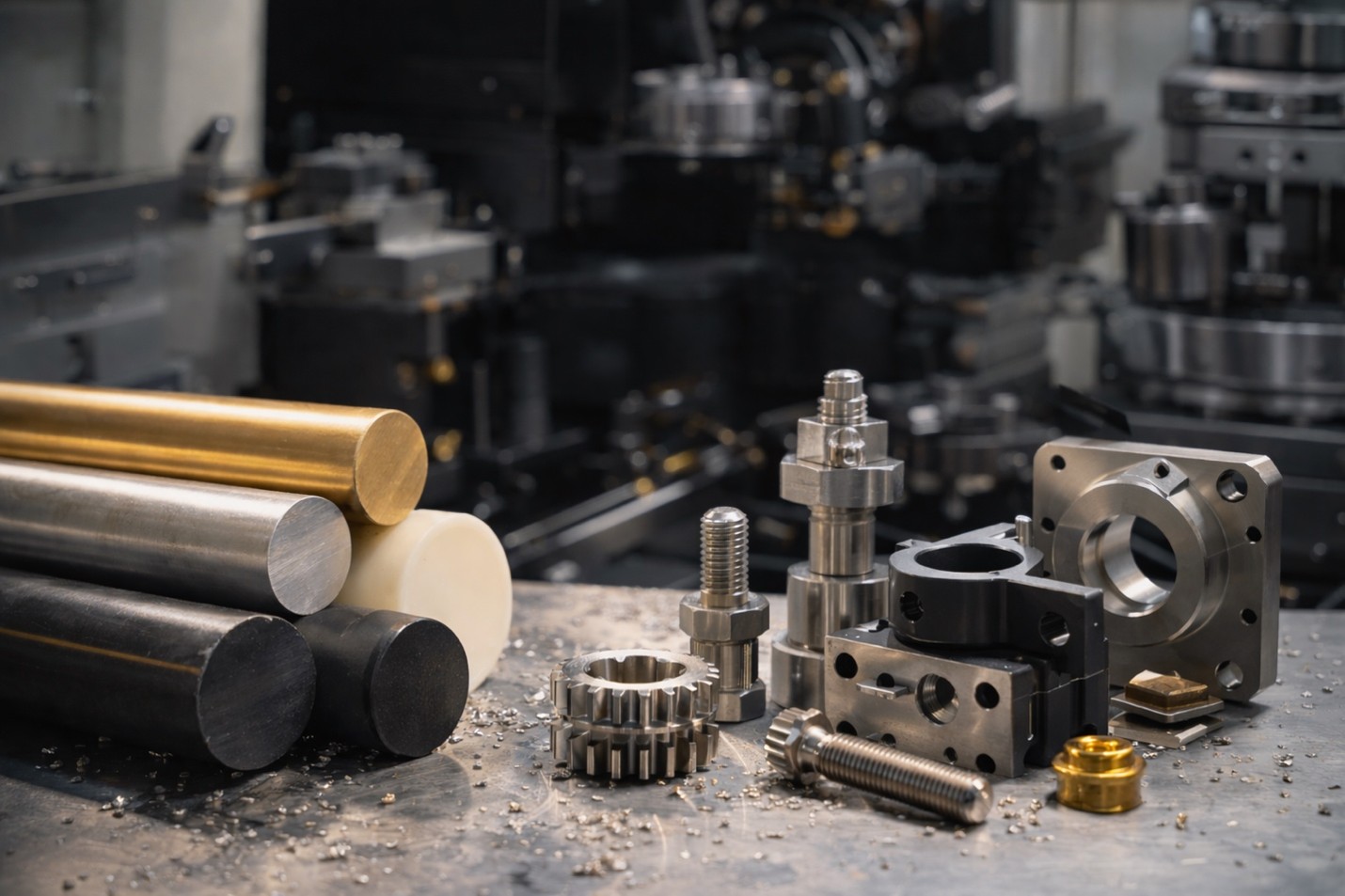
Material selection is where most CNC projects are won or lost, and where the least time is spent.
In many workflows, the material arrives already defined on the drawing. Machining adapts around it. When issues appear later, excessive tool wear, unstable finishes, or tolerance drift, they are corrected at the machine rather than traced back to the original decision.
High-performance work does not allow that separation. Material choice influences cutting forces, heat concentration, dimensional stability, and how reliably a component holds tolerance across repeated production.
Catching those effects at the specification stage costs a conversation. Catching them during production costs the batch.
The Drawing May Specify a Grade, Not a Solution
A material can meet mechanical requirements and still create problems during machining.
Stainless steels illustrate this clearly. 316 provides strong corrosion resistance but resists cutting, promotes work hardening, and shortens tool life. 303 machines far more easily due to sulphur content, yet sacrifices corrosion performance. Treating them as interchangeable shifts the problem downstream.
The same pattern appears across alloys:
- 7075 aluminium delivers higher strength than 6061 but requires tighter control during finishing to avoid surface tearing
- Hardened steels improve wear resistance but increase cutting forces and heat concentration
- Precipitation-hardened alloys behave differently depending on heat treatment condition
Material selection cannot stop at datasheet properties. It must account for how the material behaves under the cutter.
Machinability Changes More Than Expected
Machinability is rarely consistent even within the same material family.
6061-T6 aluminium allows aggressive feeds and clean chip evacuation, making it suitable for high-speed production. 7075-T6 increases strength but demands tighter finishing control, particularly in thin sections where surface damage appears quickly.
In more demanding materials, the differences become sharper:
- Titanium alloys retain heat at the cutting edge instead of transferring it through the chip, accelerating tool wear when engagement becomes inconsistent
- Nickel-based alloys harden during cutting, so any dwell or hesitation increases resistance on the next pass
Parameter selection, tooling choice, and cycle planning all shift based on these behaviours.
A programmer who treats titanium and 6061 as equivalent machining problems will discover the difference in scrapped tools, not in the CAM file.
Strength Comes With a Cost in Machining
Materials selected for performance often resist machining by design.
Alloys that maintain strength at elevated temperatures also resist deformation during cutting. Cutting forces increase, heat concentrates at the tool edge, and tool life shortens. The same properties that make a component durable in service create difficulty during production.
These effects show up immediately in cycle time and tool consumption. Without accounting for them early, estimates become unreliable and production margins shrink under real cutting conditions.
Specifying high-performance alloys without adjusting cost models, tooling budgets, and cycle estimates is where project margins quietly disappear.
Surface Integrity Depends on Material Response
Surface finish and dimensional accuracy are shaped by how a material reacts during cutting.
Materials with low thermal conductivity retain heat in the cutting zone. Localised expansion affects dimensional stability, particularly in thin-walled features or precision bores where small shifts move parts out of tolerance after cooling.
Work-hardening materials behave differently. A pass that removes too little material hardens the surface ahead of the tool. Subsequent passes encounter higher resistance, increasing tool wear and affecting finish quality.
Managing these conditions requires:
- Controlled depth of cut to avoid partial engagement
- Stable finishing passes that remove minimal stock
- Consistent feed rates to maintain uniform cutting pressure
On thin sections, uncontrolled heat and inconsistent engagement often lead to distortion that cannot be corrected after machining.
Production Conditions Reveal What Trials Do Not
A material that performs well in a single test part may behave differently across a full batch.
Tool wear patterns change over time. Heat builds across repeated operations. Chip evacuation becomes less predictable in deep features. Variation increases as the run progresses.
Factors that influence production reliability include:
- Tool life consistency: stable wear allows planned tool changes instead of unexpected stoppages
- Chip behaviour: long or irregular chips increase recutting and surface damage
- Thermal response: materials sensitive to heat variation require tighter control to hold tolerance
- Residual stress release: internal stresses can distort geometry after machining
These effects rarely appear during initial trials. They surface when production runs at scale.
Post-Processing Doesn’t Forgive the Wrong Grade
Material selection continues to matter after machining is complete.
Surface treatments and finishing processes depend on the base material behaving as expected. An incorrect choice at this stage leads to rejection rather than rework.
Key considerations include:
- Corrosion resistance requirements influencing stainless steel selection
- Compatibility with anodising in aluminium components
- Response to heat treatment or stress relief cycles
- Coating adhesion across different material surfaces
Specifying 303 stainless where passivation is required is not a minor substitution. It leads directly to part rejection.
Material Choice Shapes Cost More Than Machine Settings
Efficiency efforts often focus on machine optimisation. Material selection has a broader impact.
Difficult-to-machine alloys increase cycle time, accelerate tool wear, and raise the likelihood of rework. These effects compound across production and outweigh gains from minor parameter adjustments.
A well-chosen material supports stable cutting conditions, predictable tool life, and consistent output across the batch.
Cost control begins before machining starts.
The Decision That Cannot Be Corrected Later
Material selection defines how the entire process behaves.
Changing a material specification after programming has begun costs time. Changing it after the first batch has run costs significantly more. Getting it right at the specification stage costs nothing except the discipline to question whether the selected grade supports both performance and manufacturability.
That decision determines whether the process runs smoothly or spends its time being corrected.
For enquiries, reach us as follows:
Email:
sales@offshoresynergy.ae
Phone:
+971 7 208 1300
Website:
www.offshoresynergy.ae
