
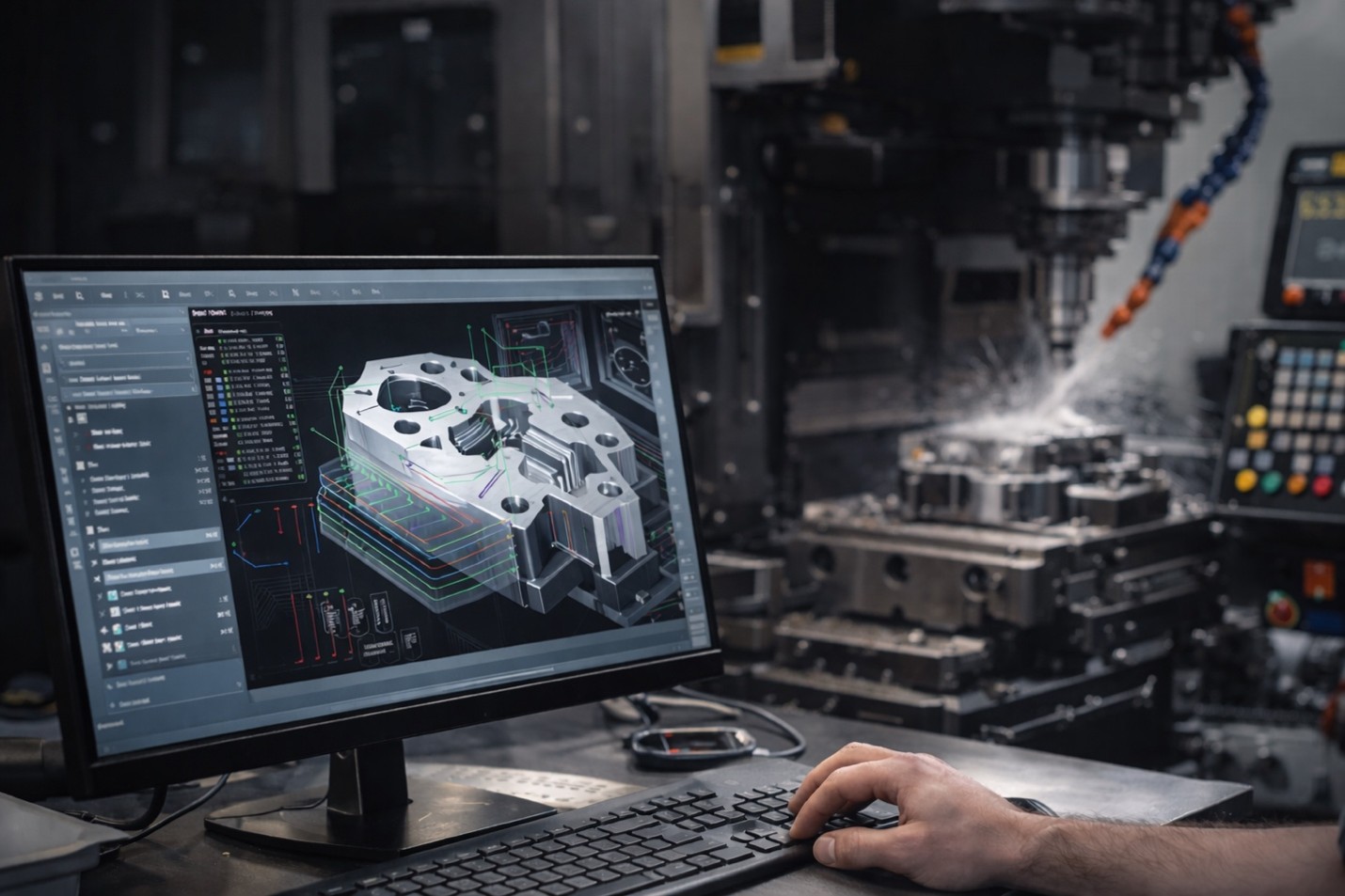
Most CNC shops do not struggle with machining capability. They struggle with how the job is programmed before it reaches the machine.
Cycle delays, premature tool wear, repeated finishing passes, and inconsistent results rarely originate at the spindle. They build up earlier, when toolpaths are loosely defined, cutting conditions are guessed, or access is planned around limitations rather than controlled.
CAD/CAM shifts that burden upstream.
Instead of resolving problems during machining, the entire operation is structured in advance. Geometry, cutter engagement, feed strategy, and sequencing are defined before execution. The machine runs a resolved process rather than compensating for uncertainty.
That change alone removes a large portion of avoidable inefficiency.
The Real Bottleneck Sits Before the First Cut
On most shop floors, lost time rarely comes from a single slow operation. It accumulates in smaller gaps across the cycle.
Feed rates are reduced to prevent chatter. Operators pause to adjust offsets. Extra finishing passes are added because the first pass did not hold tolerance. Tools are changed earlier than expected because wear becomes inconsistent.
None of these issues begins during cutting. They reflect decisions made earlier.
CAD/CAM allows those decisions to be tested and corrected before machining begins. Instead of reacting to instability, the process is stabilised in advance.
Time lost between operations is where most schedules slip, not during the cut itself.
From Geometry to Toolpath Without Reinterpretation
Manual programming introduces variation even in experienced teams. Entry strategies, stepovers, and cutting orders often depend on individual preference.
CAM removes that layer. Toolpaths are generated directly from the model. Profiles, pockets, and complex surfaces define how the cutter moves. Parameters are calculated based on geometry and material rather than being assumed during programming.
This leads to:
- Consistent toolpath logic across different programmers
- Reduces the need to test alternate strategies
- Tighter alignment between model tolerance and machined result
The process becomes repeatable because its logic is consistent.
Stable Engagement Drives Real Throughput
Aggressive cutting parameters alone do not improve output. Instability forces operators to slow down or repeat operations, cancelling any gains.
CAM strategies focus on maintaining constant cutter engagement. Instead of sharp directional changes that spike load, toolpaths follow smooth transitions. Chip thickness remains within a controlled range, allowing feed rates to increase without overloading inserts or end mills.
In materials that punish inconsistency, such as stainless or heat-resistant alloys, uneven engagement leads to rapid edge breakdown and unpredictable wear. Controlled engagement prevents that failure pattern.
The result is not just faster cutting, but cutting that holds steady across the entire cycle.
Run It Virtually, Then Commit to the Cut
Trial machining consumes machine time and ties up resources. Adjustments made on the machine extend cycle time and disrupt scheduling.
Simulation removes that dependency. The complete machining sequence is verified digitally. Tool reach, holder clearance, fixture interference, and sequencing are checked before production. Inefficient motion and collision risks are addressed early.
Typical refinements at this stage include:
- Adjusting roughing order to reduce non-cutting travel between cavities
- Refining stepovers to remove visible witness marks on finishing passes
- Repositioning fixtures to improve tool access without extending reach
A missed collision in programming does not slow production. It stops it completely, often with tooling damage attached.
Once these issues are resolved digitally, machining runs without repeated intervention.
Accuracy Starts With How Material Is Removed
Dimensional accuracy does not depend on inspection alone. It is shaped by the structure of each stage of material removal.
CAM separates roughing, semi-finishing, and finishing into controlled stages. Each stage uses parameters suited to its purpose rather than relying on a single approach throughout.
This structure allows:
- Bulk material removal without distorting geometry
- Stabilisation of surfaces before final passes
- Finishing cuts that remove minimal stock under controlled conditions
On thin-walled parts, skipping semi-finishing often leads to part deflection during final passes, which no amount of inspection can correct afterwards.
The outcome is more predictable tolerance control and surfaces that require little to no correction after machining.
Fewer Setups, Fewer Variables
Every additional setup introduces another variable. Repositioning a part increases the risk of slight misalignment, especially when multiple features must relate precisely.
Multi-axis strategies reduce that dependency. CAM calculates how to approach different faces within a single setup. Five-axis motion allows the tool to reach complex features without repeated repositioning.
This reduces:
- Setup time between operations
- Accumulated alignment error
- Reliance on complex or overbuilt fixtures
Misalignment rarely shows up immediately. It appears later when features fail to relate to each other.
Less handling improves both speed and reliability.
Eliminate Movement That Adds No Value
A significant portion of machining time can be lost to movement that does not contribute to the part.
Air cutting, redundant passes, and inefficient linking moves extend cycle time without improving quality.
CAM addresses this by tracking remaining stock and adjusting toolpaths accordingly.
Improvements become visible when:
- Roughing sequences are reordered to reduce long non-cutting moves
- Linking paths are shortened to keep the tool engaged where possible
- Previously machined areas are excluded from subsequent passes
Each adjustment removes wasted motion, tightening the cycle without increasing risk.
Where Efficiency Gains Become Measurable
Once CAD/CAM is fully integrated, improvements show up in routine operations rather than isolated metrics:
- Programming time shortens because toolpaths follow defined strategies
- Cycle times stabilise due to consistent engagement
- Tool life becomes predictable rather than reactive
- Rework rates drop with improved first-pass accuracy
- Machine availability improves with fewer interruptions
These gains do not rely on pushing machines harder. They come from removing inconsistency.
Replace Assumptions With Measurable Planning
Uncertainty in scheduling often comes from relying on estimates rather than defined parameters.
CAM provides clear projections before machining begins. Cycle time, tool usage, and the operation sequence are calculated during programming.
This allows:
- Accurate planning of machine capacity
- Better coordination between jobs
- Fewer unexpected delays during production
A job that runs for four hours should not take three hours to plan because dependencies were never calculated.
Where Efficiency Actually Comes From
The shops that hold tolerance across a full run, hit schedules, and extend tool life are not running different machines. They resolved the process before the machine was switched on.
CAD/CAM supports that level of control at the stage where it matters most.
The outcome is not faster machines. It is fewer interruptions, fewer corrections, and output that holds from the first part to the last.
For enquiries, reach us as follows:
Email:
sales@offshoresynergy.ae
Phone:
+971 7 208 1300
Website:
www.offshoresynergy.ae
